
Guru Purnima at Shirdi Sai Baba Temple: What Devotees Should Know
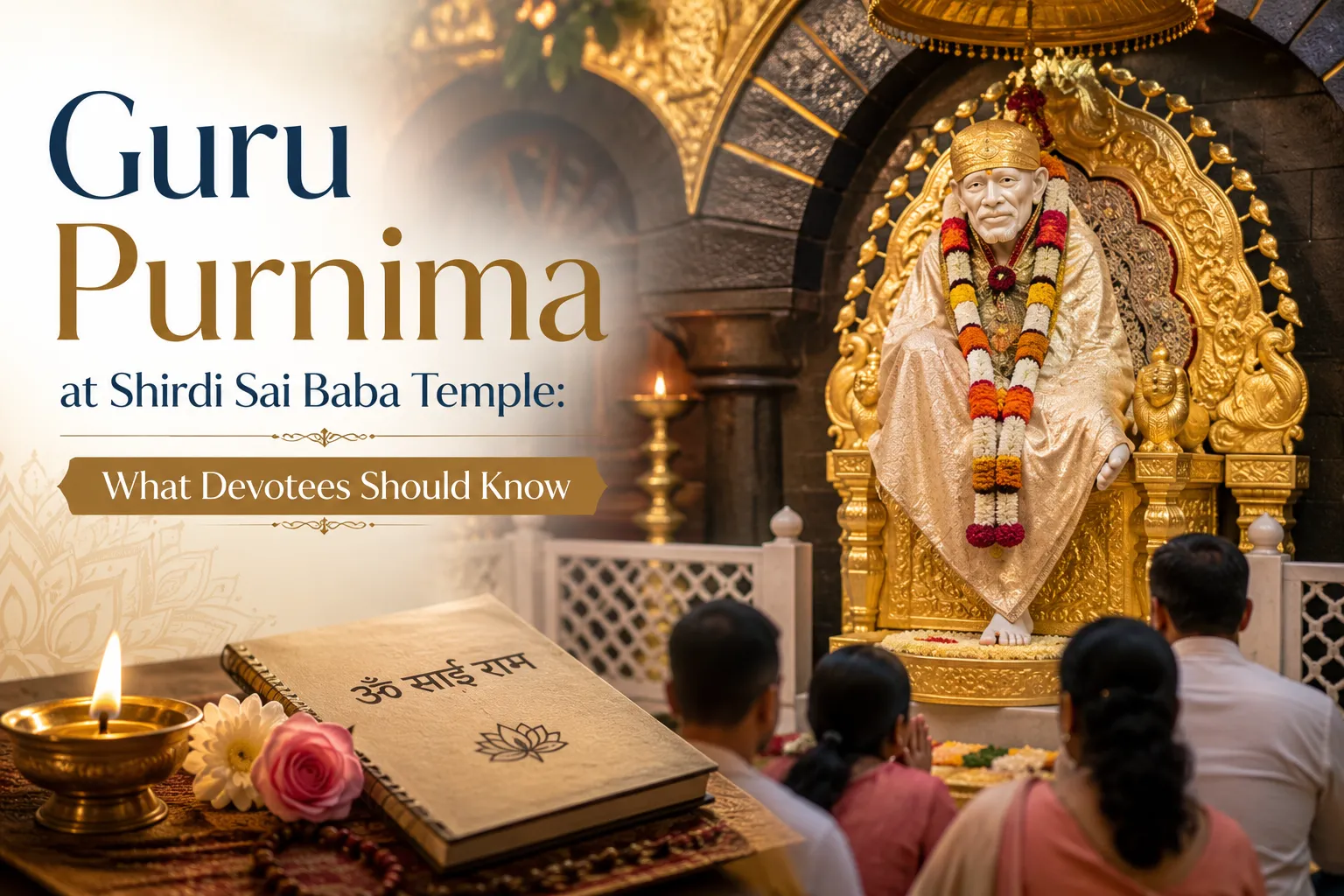
Guru Purnima at Shirdi Sai Baba Temple: What Devotees Should Know
Kavitha had been to Shirdi three times before.
She had done the early morning Kakad Aarti, stood in the queue for darshan, visited the Dwarkamai, and sat beside the eternal Dhuni. Each visit had its own quality of experience, its own particular grace.
But nothing had prepared her for Guru Purnima.
She arrived the evening before, when the town was already beginning to fill. By the time she woke at four in the morning, the streets outside her hotel were already alive with devotees making their way toward the temple. By the time she reached the queue, it stretched further than she had ever seen. And when the Kakad Aarti began, and the atmosphere inside the temple complex reached a level of devotion she later described simply as indescribable, Kavitha understood something she had not understood on her previous visits.
There are ordinary days at Shirdi. And then there is Guru Purnima.
They are not the same thing.
What is Guru Purnima and Why Does It Matter
Guru Purnima falls on the full moon day of the Hindu month of Ashadha, which typically arrives in July. In 2026, Guru Purnima falls on 29 July.
The day is one of the most significant in the Hindu calendar, dedicated to expressing gratitude and reverence for the Guru. In Sanskrit, Guru means the one who dispels darkness. Purnima means full moon. The symbolism is precise and intentional: just as the full moon illuminates the night sky with its complete and undimmed light, the Guru illuminates the disciple’s path with wisdom, grace, and truth.
The tradition of Guru Purnima is ancient. It is said to be the day on which Maharshi Veda Vyasa, the great sage who compiled the Vedas and authored the Mahabharata, was born. It is also considered the day on which the Adi Guru — the first teacher — began transmitting spiritual knowledge to humanity. Across traditions and lineages, it is the day on which disciples pause everything else and turn their complete attention toward the one who showed them the way.
At Shirdi, this day carries a significance that is both deeply traditional and entirely specific to the extraordinary being who once lived here.
Why Guru Purnima is Especially Sacred at Shirdi
Sai Baba was, above all else, a Guru.
He was not a Guru in a formal or institutional sense. He had no ashram with a prescribed hierarchy, no formal initiation ceremony, and no registered disciples. What he had was something that defied easy categorization: an extraordinary, unshakeable ability to meet each devotee exactly where they were, to see through the surface of their circumstances into the heart of what they needed, and to guide them — through his presence, his words, his seeming simplicity, and his occasional sharpness — toward something larger than themselves.
Devotees who came to him with illness received healing. Those who came with grief received comfort. Those who came with pride received a quiet, humbling redirection. And those who came with genuine spiritual longing received something that stayed with them for the rest of their lives.
He embodied the Guru principle so completely that Guru Purnima at Shirdi is not a borrowed tradition adapted to his memory. It is a natural expression of who he was and what he continues to mean to millions of devotees.
On Guru Purnima, Shirdi becomes the place where every devotee who has ever been touched by Baba’s grace returns to say thank you. Not for a specific miracle or a particular blessing, though many have those stories. But for the larger, quieter gift of being seen, guided, and held — even across distance and time.
What Happens at Shirdi on Guru Purnima
The Shirdi Sai Baba Sansthan organises Guru Purnima with great care and reverence, and the day follows a well-planned schedule that honours both the occasion and the thousands of devotees who gather to celebrate it.
The celebrations typically begin a day or two before Guru Purnima itself, with special programmes, bhajans, and pravachans in and around the temple complex. On Guru Purnima day, the temple opens earlier than usual, and the schedule of aartis — Kakad Aarti at dawn, Madhyan Aarti at noon, Dhoop Aarti in the evening, and Shej Aarti at night — is conducted with special fervour and elaborate offerings.
The paalkhi procession is one of the most moving experiences of the day. Baba’s padukas — his sacred footwear, which represent the Guru’s presence in a tradition as old as the guru-shishya relationship itself — are carried in a ceremonial procession with devotees following behind in a state of complete absorption. Watching the paalkhi move through the streets of Shirdi, surrounded by devotees in tears, in prayer, in song, is an experience that no photograph can adequately prepare you for.
The Dwarkamai — the mosque that Baba called home — draws particularly large numbers of devotees on this day. Sitting in the space where Baba actually lived, beside the Dhuni whose flame has never been extinguished, receiving the sacred udi — on Guru Purnima, these experiences carry a weight that is difficult to put into words.
Crowds on Guru Purnima are significant. This is not a deterrent for the devoted pilgrim — it is part of the experience. The collective energy of hundreds of thousands of devotees gathered in one place, all turned toward the same being in the same spirit of gratitude, creates an atmosphere that even first-time visitors feel immediately and unforgettably.
What Devotees Should Know Before Visiting
If you are planning to visit Shirdi for Guru Purnima 2026 on 29 July, here is what will make your experience smoother and more meaningful.
Book early, without exception. Shirdi receives hundreds of thousands of devotees on Guru Purnima. Hotels, lodges, and dharamshalas fill up weeks — sometimes months — in advance. If you are traveling from Bangalore or any other city and have not yet made your arrangements, begin now. A well-organized pilgrimage package that handles accommodation, travel, and darshan coordination will save you considerable difficulty upon arrival.
Plan for crowds and pace yourself. Darshan queues on Guru Purnima can be long. This is not the day to visit if you are in a hurry or if prolonged standing is a physical concern. Build the day around patience and presence rather than a tight schedule.
Arrive the evening before if possible. Many devotees choose to arrive on the evening of 28 July to participate in the early morning Kakad Aarti on Guru Purnima. The peaceful pre-dawn atmosphere is widely regarded as one of the most spiritually uplifting moments of the entire pilgrimage. The quieter energy of the early hours before the main crowds build is worth the early start.
Dress appropriately and travel light. Lightweight, modest clothing suitable for temple visits is recommended. Carry only a small bag with essentials such as water, any necessary medication, and a phone charger, and leave everything else at the hotel. Navigating a crowded temple complex is much easier without heavy luggage.
Use the Paalkhi procession as an anchor. If the darshan queue is long, time spent watching or following the Paalkhi procession is never wasted. Many devotees describe the procession as the moment Guru Purnima truly became real for them.
Stay for the evening Aarti if you can. The Dhoop Aarti and Shej Aarti on Guru Purnima are marked by an atmosphere of deep devotion and spiritual grandeur, making them among the most memorable experiences of the celebration. If your travel plans allow you to stay until the evening, it is an experience well worth having.
Conclusion
There is a line attributed to Sai Baba that devotees carry with them everywhere: Sabka Malik Ek. One God. One truth. One source.
Guru Purnima is the day when that truth feels most tangible. When the distinctions between tradition, religion, background, and circumstance fall away, what remains is simply a gathering of people who have been touched by something larger than themselves and have come to say so.
If you have been thinking about visiting Shirdi for some time, Guru Purnima 2026 on 29 July is the visit to make. Not because any day at Shirdi is ordinary, but because some days hold a quality of grace that is simply deeper than others.
This is one of them.
Planning your Shirdi Guru Purnima pilgrimage from Bangalore? Balaji Tour Package organises comfortable, well-coordinated Shirdi packages with darshan coordination, accommodation, and everything arranged so your attention stays exactly where it belongs — on the experience itself. Get in touch with us today.

All Categories
Recent Posts
Guru Purnima at Shirdi Sai Baba Temple: What Devotees Should Know

The Story Behind Sai Baba’s Eternal Dhuni