
The Story Behind Sai Baba’s Eternal Dhuni
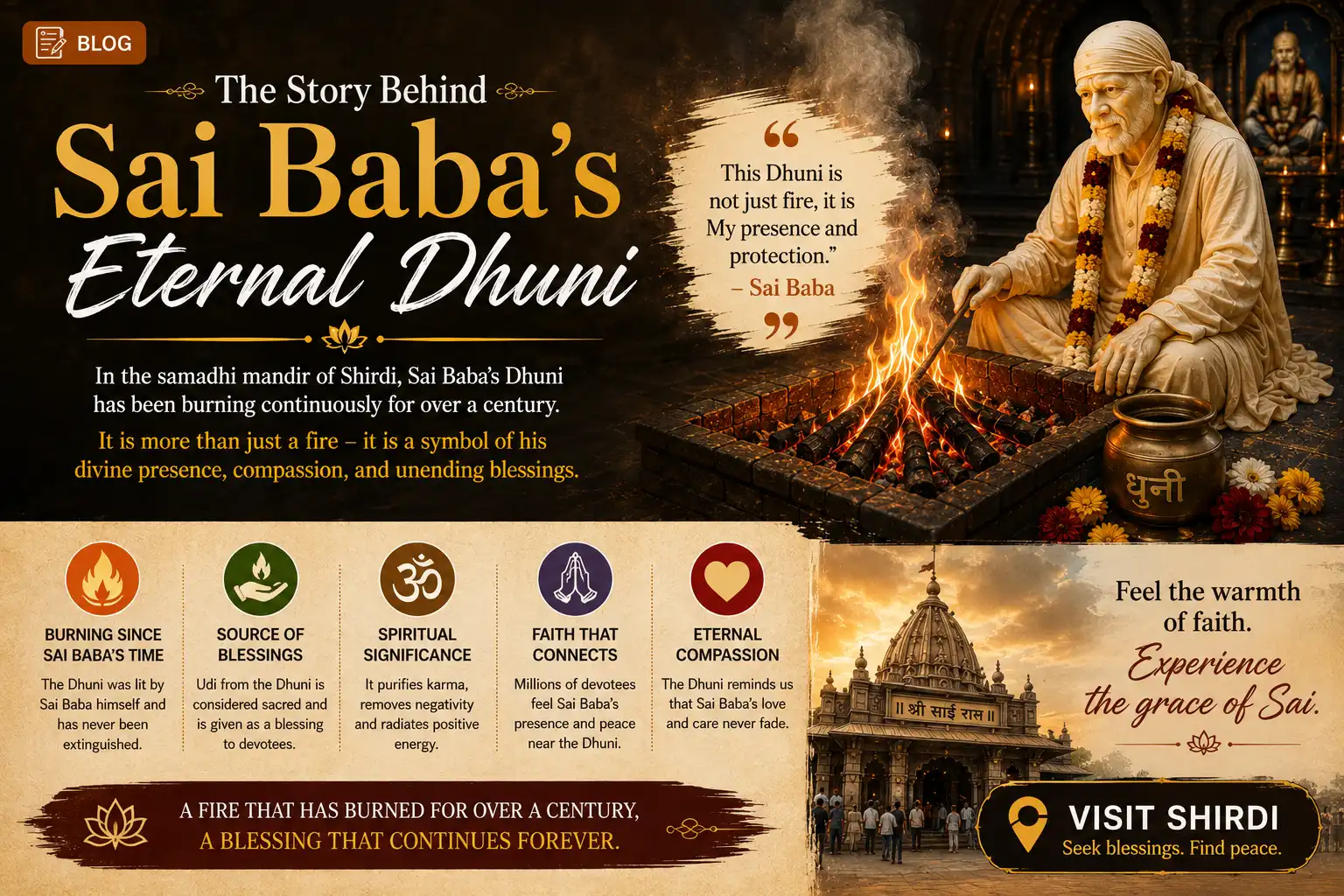
The Story Behind Sai Baba’s Eternal Dhuni
There is a fire in Shirdi that has not gone out in over a hundred years.
Not a symbolic fire. Not a fire that is rekindled each morning by a priest following a ritual schedule. An actual flame that has been burning continuously since Sai Baba himself lit it, sometime in the late nineteenth century, in a small mosque in a small village in Maharashtra that most of the world had never heard of.
That fire is called the Dhuni. And for the millions of devotees who visit Shirdi each year, it is one of the most sacred and most quietly extraordinary things they will encounter on their pilgrimage.
This is the story behind it.
The Mosque That Was Not a Mosque
Before we can understand the Dhuni, we need to understand the place where it burns.
The Dwarkamai is the structure that Sai Baba called home for most of his life in Shirdi. It was, in its original form, a dilapidated mosque that Baba occupied when he arrived in Shirdi as a young man. The villagers were surprised by his choice of dwelling. Some were confused by it. Here was a man who appeared to be a Hindu sadhu, living in an abandoned Muslim prayer space, lighting a fire on its floor, and inviting everyone who came to him, regardless of faith, caste, or background, to sit beside it.
Baba called the structure Dwarkamai, a name with deep roots in both Hindu and Islamic tradition. He swept and cleaned it himself. He decorated it with his own hands. And at its center, he lit the Dhuni.
From that moment, the fire never went out.
What the Dhuni Meant to Sai Baba
For Sai Baba, the Dhuni was not merely a fire. It was a living, breathing expression of his spiritual philosophy and his compassion for the suffering of fellow human beings.
Baba used to sit beside the Dhuni for hours. Devotees who came to him with illness, grief, financial ruin, or broken relationships would sit across from him, and Baba would tend the fire as he spoke with them. He would feed it with pieces of wood, stoke its flames, and occasionally reach into it with his bare hands, an act that witnesses described with astonishment and that no one could explain.
The udi, or sacred ash from the Dhuni, became one of the most powerful expressions of Baba’s healing presence. He would give it to devotees as a blessing, pressing it into their palms or foreheads with a simplicity that contained everything. Countless accounts exist of the udi healing illness, bringing peace to troubled minds, and arriving at the homes of devotees who had not even visited Shirdi but had simply prayed to Baba from a distance.
For Baba, the Dhuni was a form of sacrifice. He spoke of it as consuming the karmic burdens of those who came to him. Every piece of wood he fed into it, every flame that rose from it, was understood by him as a burning away of the difficulties, the debts, and the suffering of his devotees.
He was, in a sense, burning their problems so they did not have to carry them.
The Night That Changed Everything
One of the most famous stories connected to the Dhuni involves a night when Baba abruptly began pulling down all the lamps in the Dwarkamai, extinguishing them one by one, and throwing them into the street outside.
The villagers were alarmed. Some thought Baba had lost his composure. Others watched in confused silence as he moved through the mosque, methodically removing every source of light until only the Dhuni remained, burning at the center of the darkened room.
It was only later that people understood what had happened. In another part of Shirdi, or in some accounts, in another village entirely, a house fire had broken out that night, but it had been extinguished before it could cause harm. Devotees who understood Baba’s ways believed that he had drawn the fire toward himself and into the Dhuni, protecting the people and the property that would otherwise have been destroyed.
The story may be literal. It may be symbolic. What it is, without question, is true in the way that only the most enduring stories are: it tells you exactly who Baba was and what the Dhuni meant to him. It was not simply a fire he maintained. It was an extension of himself. A tool of protection. A living presence that he directed with intention.
The Dhuni After Baba’s Mahasamadhi
Sai Baba took Mahasamadhi, leaving his physical body, on October 15, 1918.
The Dhuni did not go out.
In the days, weeks, and years that followed Baba’s passing, the flame continued to burn in the Dwarkamai exactly as it had burned during his lifetime. The priests and trustees of the Shirdi Sai Baba Sansthan maintained it with the same care and reverence that Baba himself had brought to it.
Today, more than a hundred years after Baba’s Mahasamadhi, the Dhuni still burns. The Udi it produces is still distributed to devotees every day. For pilgrims from across India and around the world, sitting before the sacred fire, receiving the udi, and quietly absorbing the atmosphere of the Dwarkamai is a way to feel the same profound presence that Baba’s devotees once felt sitting beside him.
For those who believe, the continuity of the flame across more than a century is not a logistical feat. It is a statement. Baba is still here. The fire he lit has not gone out because he has not gone away.
What Devotees Experience at the Dhuni Today
For first-time visitors to Shirdi, the Dwarkamai and the Dhuni are often described as the most unexpectedly moving part of the pilgrimage.
The Shirdi Sai Baba temple complex draws enormous crowds. The main temple, where Baba’s marble samadhi stands, is an experience of scale and devotion. But the Dwarkamai is smaller, older, and quieter in its energy. Sitting in the space where Baba actually lived, looking at the fire he actually lit, and receiving the udi from the same Dhuni that gave udi to the sick, the grieving, and the desperate in the late 1800s, produces in many devotees a quality of stillness that is difficult to prepare for.
The udi received at the Dwarkamai is considered among the most sacred forms of prasad in the Shirdi pilgrimage. Devotees keep it in their homes, apply it during prayer, and bring it to family members who were unable to make the journey. The belief is consistent across the decades: the udi carries Baba’s blessing directly, as it always has, because the fire it comes from has never stopped.
Planning Your Visit to the Dhuni at Shirdi?
For devotees planning a Shirdi pilgrimage from Bangalore, a visit to the Dwarkamai and time at the Dhuni should be considered essential parts of the itinerary rather than optional additions.
The Dwarkamai is located within the Shirdi temple complex and is accessible to all pilgrims. The udi distribution happens throughout the day. Early morning visits, when the complex is quieter and the light through the old stone walls has a particular quality, are especially memorable.
A well-organized Shirdi package from Bangalore will include time at the Dwarkamai as part of a thoughtfully planned itinerary, ensuring that the visit feels unhurried and meaningful rather than rushed between other stops.
At Balaji Tour Package, our Shirdi pilgrimage packages from Bangalore are designed with exactly this in mind. The Dhuni is not a footnote on our itinerary. It is one of the central experiences we plan around, because we understand what it means to the devotees who travel with us.
The fire has been burning for over a hundred years.
It will be burning when you arrive.
Planning a Shirdi pilgrimage from Bangalore? Get in touch with Balaji Tour Package today. We organize comfortable, well-coordinated Shirdi packages that give you the time and space to experience every sacred moment of this extraordinary journey.

All Categories
Recent Posts

How to Plan a Tirupati Srikalahasti Trip from Bangalore Without the Travel Hassle

Five Temples Every Devotee Must Visit in Tirupati Beyond the Main Darshan